Household Cleaning Tools Clipart: Practical Visual Assets for Modern Projects
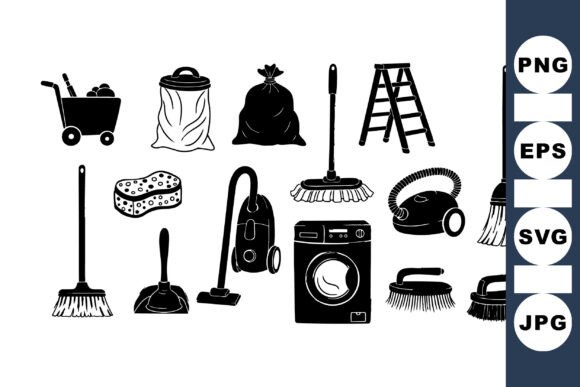
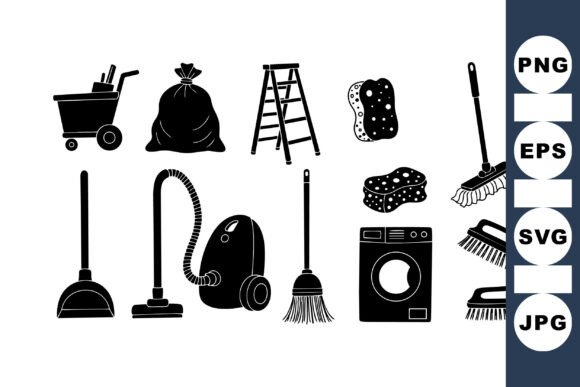
When designing materials related to home maintenance, organization, or domestic services, finding visuals that are both professional and universally recognizable can be a challenge. Photographs often carry too much visual noise or specific branding, while complex illustrations can clash with clean layouts. This is where a dedicated collection of household cleaning tools clipart becomes an essential asset. Specifically, a set featuring black silhouette icons of vacuums, brooms, mops, scrubbing brushes, ladders, washing machines, and sponges offers a level of versatility that full-color graphics simply cannot match. These minimalist flat-style vectors serve as functional design elements rather than mere decoration, allowing creators to communicate concepts instantly without distracting from the core message.
Why Silhouette Icons Work Across Different Media
The decision to use black silhouettes in a flat style is rooted in practical utility. Unlike detailed raster images, these vector-based icons are resolution-independent. A small business owner creating a flyer for a local janitorial service needs the vacuum icon to look crisp on a 4x6 postcard and equally sharp on a large vinyl banner. Because this collection includes SVG and EPS files, the graphics scale infinitely without pixelation. Furthermore, the solid black color acts as a neutral canvas. It provides maximum contrast against white backgrounds but can be easily recolored in design software to match a specific brand palette. If a cleaning company uses teal and grey branding, these icons can be adjusted to teal in seconds, maintaining visual consistency across all marketing touchpoints.
Streamlining Commercial Branding and Marketing
For entrepreneurs and marketers in the home services sector, time is money. Creating custom iconography from scratch for every new campaign is rarely feasible. Having a pre-made library of household cleaning tools clipart accelerates the production of digital ads, social media posts, and website landing pages. Consider a residential cleaning franchise launching a spring cleaning promotion. They need to quickly convey "deep clean" services across Instagram, Facebook, and email newsletters. Using the scrubbing brush and sponge icons creates an immediate visual association with thoroughness. The minimalist aesthetic ensures the icons don't compete with promotional text or call-to-action buttons, guiding the viewer’s eye exactly where it needs to go.
Beyond advertising, these assets are vital for operational clarity. Property management companies often create tenant handbooks or move-in checklists. A wall of text detailing cleaning responsibilities can feel overwhelming and adversarial. Integrating friendly, simple icons next to checklist items—such as a mop symbol next to "kitchen floors" or a washing machine icon next to "laundry area protocols"—breaks up dense information. This improves readability and compliance because tenants can scan the document visually. The universal nature of silhouettes also helps bridge language barriers in multi-lingual communities, making instructions accessible to non-native speakers without requiring expensive translation services for every minor update.
Educational and Instructional Applications
Educators, homeschoolers, and content creators focusing on life skills benefit significantly from this type of visual resource. Teaching children or young adults about household chores requires clear, non-intimidating visuals. A realistic photo of a messy room might induce anxiety, whereas a clean line-art icon of a broom represents the tool and the task abstractly. When creating chore charts, reward systems, or educational worksheets, these icons provide a consistent visual language. A teacher developing a lesson plan on hygiene and sanitation can use the sponge and scrubbing brush graphics to illustrate proper techniques without the distraction of specific product brands found in stock photography.
This utility extends to adult education and vocational training as well. Instructors teaching facilities management or hospitality standards need standardized visuals for training manuals. When explaining the difference between dusting (broom/duster) and sanitizing (spray/sponge), distinct icons help categorize tasks mentally for trainees. The inclusion of a ladder icon is particularly important for safety training modules regarding high-dusting or window cleaning, serving as a visual cue for safety protocol reminders. Because the files are available in PNG and JPG formats, instructors can easily drag and drop them into PowerPoint presentations, Word documents, or learning management systems without needing advanced graphic design skills.
Digital Product Creation and Blogging
Bloggers and digital product creators operate in a niche where aesthetics drive engagement. Lifestyle bloggers writing about decluttering, minimalism, or eco-friendly living often seek visuals that align with a calm, organized aesthetic. The flat, minimalist style of this household cleaning tools clipart fits seamlessly into modern web design trends. Instead of using generic stock photos that appear on thousands of other sites, bloggers can incorporate these unique silhouettes as dividers, bullet points, or featured graphics. This adds a layer of custom polish to articles about organizing pantries or reviewing cleaning products, enhancing the user experience and keeping readers on the page longer.
For those selling digital planners, printable journals, or stickers on platforms like Etsy, these assets are foundational building blocks. A creator designing a "Home Maintenance Tracker" for GoodNotes or Notion needs cohesive iconography to make the interface intuitive. The vacuum, mop, and washing machine icons serve as perfect category markers. Since the ZIP includes transparent PNGs, there is no tedious background removal required. Creators can layer these icons over colored backgrounds or textured paper effects effortlessly. The commercial viability of such digital products often hinges on the quality and consistency of the included graphics, making a comprehensive set like this a high-return investment for digital artists.
Technical Considerations Before Downloading
While the visual appeal is important, understanding the technical specifications ensures the clipart actually solves your problem. Before integrating these assets into a project, consider the end medium. If you are working in Adobe Illustrator or CorelDRAW for print materials, prioritize the EPS or SVG files. These vector formats allow you to modify anchor points; if you need to slightly alter the shape of the scrubbing brush to better fit a specific layout curve, vectors make this possible. Raster formats like JPG and PNG are locked pixels; stretching them results in blur, and editing shapes is difficult.
Conversely, if your workflow primarily involves Canva, Microsoft Office, or web builders like WordPress, the PNG files will likely be your workhorse. Ensure you verify whether the PNGs have transparent backgrounds. For this specific collection, the transparency is crucial for overlaying icons onto colored sections of a website or presentation slide. JPGs, typically having white backgrounds, are best reserved for documents with white paper or digital layouts where a boxed icon is intentional. Also, review the licensing terms included in the download. While these icons are designed for general use, confirming whether they can be used in logos, trademarked branding, or resold as part of a larger template kit prevents future legal headaches.
Maximizing Value Through Strategic Implementation
Owning the files is only the first step; applying them strategically yields results. Avoid using the icons merely as filler. Every graphic should serve a communicative purpose. In a newsletter about seasonal home prep, place the ladder icon specifically next to the section about gutter cleaning or changing smoke detector batteries, rather than floating it aimlessly in the header. Context reinforces meaning. Additionally, consider accessibility. When using these images on websites, always include descriptive alt text. Instead of "broom icon," use "illustration of a broom representing floor sweeping tasks." This ensures screen reader users receive the same contextual information as sighted users, which is both an ethical practice and an SEO best practice.
Finally, maintain stylistic consistency. If you start using this black silhouette set, stick with it throughout the specific project or campaign. Mixing these flat icons with 3D renders or hand-drawn sketches creates visual dissonance that can make materials look unprofessional. The strength of this household cleaning tools clipart lies in its uniformity. By treating these icons as a systematic design language rather than isolated decorations, you create a cohesive visual identity that resonates with audiences, clarifies complex information, and elevates the perceived quality of your work, whether you are running a multinational facility management firm or teaching a toddler how to tidy their room.